
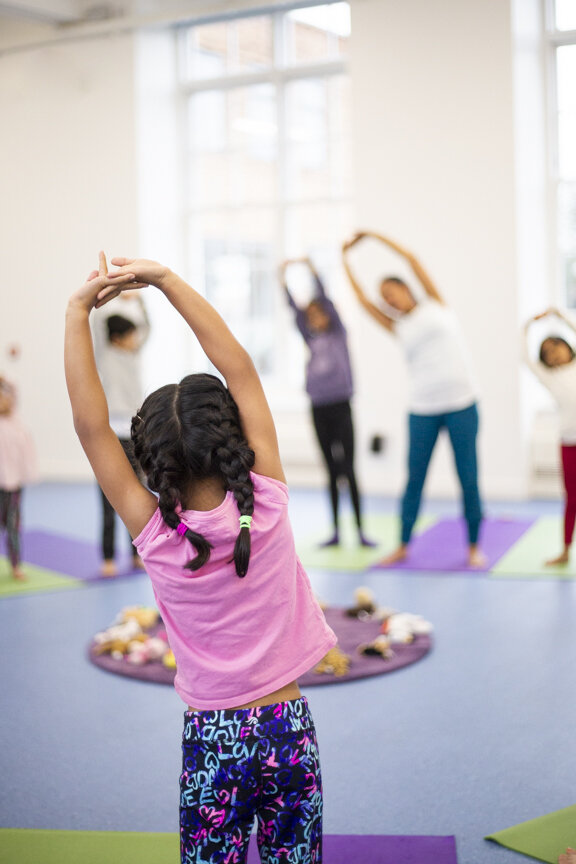
yoga for schools
An increasing number of organisations including the Association for Physical Education and the Youth Sport Trust yoga practice can meaningfully support overall wellbeing.
At Anjli Yoga, our work in schools is rooted in a simple belief:
when children and young people understand themselves, they thrive
Yoga for Schools offers children and young people practical, embodied tools to support their physical health, emotional regulation, focus and self-awareness — skills that are increasingly essential in today’s fast-moving and highly stimulating world.
National organisations such as the Association for Physical Education and the Youth Sport Trust recognise that yoga practice can meaningfully support overall wellbeing. Research continues to show the importance of movement, breath regulation and mindful awareness in supporting concentration, resilience and emotional health.
But for us, yoga is more than exercise.
It's a collection of practices that can be adapted in an age-appropriate way for children and young people to:
Notice what they're feeling
Understand how emotions show up in the body
Learn how to regulate energy and attention
Build confidence from the inside out
Preparing Children and Young People for the Future
Children and young people are growing up in an era of rapid change, digital immersion and constant information. Alongside academic knowledge, they need embodied skills that help them:
Adapt to change with flexibility
Persevere through uncertainty
Communicate with emotional intelligence
Collaborate with empathy
Maintain focus in stimulating environments
Trust their own inner guidance
Yoga provides structured opportunities to practise these skills in real time.
Through movement, balance, breath and reflection, Children and Young People learn how to self-regulate rather than react to external influences.
This is how we gently support the shift from overwhelm to awareness.
Yoga for Children and Young People Is Unique
Children’s yoga and yoga for young people are not simplified adult classes.
They're developmentally informed practices that use:
Storytelling and imagination
Partner and group collaboration
Playful sequencing
Interoceptive awareness (noticing internal sensations)
Accessible language for emotional literacy
Sessions are stimulating and engaging, yet intentionally structured to support calm focus and embodied confidence.
Children and young people aren't asked to perform or perfect poses.
They're invited to explore and notice.
The Anjli Yoga Approach: 5 Principles to Wellbeing
Our school programmes are guided by five integrated principles:
Connection – to self and world
Through engaging themes and relevant curriculum links, Children and Young People explore their bodies, thoughts and emotions in an age-appropriate way, strengthening both self-awareness and empathy.
Physical movement
Stretching to release tension and emotional holding
Strength-building to develop resilience and confidence
Sequencing to improve coordination, motivation and body awareness
Movement becomes a safe outlet for energy and feeling.
3. Balance
Balance postures develop:
Concentration
Focus
Steady attention
Emotional equilibrium
Children and young people learn how to steady their bodies and, in turn, steady their minds.
4. Breath awareness
Breathing techniques are used to:
Calm heightened states
Gently energise low states
Support “whole-brain” integration
Improve clarity and readiness for learning
Breath becomes a tool Children and Young People can access independently.
5. Relaxation moments
Short reflective practices support:
Relaxation
Nervous system regulation
Emotional processing
Mental resilience
These moments create space for integration rather than constant stimulation.
Supporting Curriculum and Whole-School Wellbeing
Anjli Yoga complements:
The National Curriculum
PSHE and RSE programmes
Spiritual, Moral, Social and Cultural (SMSC) Education
Whole-school wellbeing strategies
Yoga themes can be woven into classroom learning, enhancing engagement while supporting emotional and social development.
Example Programmes
Primary:
Topic-linked yoga (Romans, Egypt, Environment, Festivals including Chinese New Year, Vesak, Diwali)
Tolerance, diversity and healthy bodies
Exam preparation workshops (focus, calm, confidence)
Year 6–7 transition workshops on change and resilience
Secondary
Personal Power Yoga
Building Brain Connections Yoga
Right Time, Right Energy
Yoga for Calm
Yoga for Sleep
Yoga for Flexibility
Yoga to Support the Menstrual Cycle
Exam-season resilience workshops
Bespoke programmes can be designed to meet specific school needs.
The vision
At Anjli Yoga, our vision is to help guide children and young people toward deeper self-understanding, emotional literacy and embodied confidence.
In a world that often pulls attention outward, yoga gently guides it inward — helping children and young people develop the awareness, compassion and resilience that support not only academic success, but lifelong wellbeing.
When children and young people learn to understand themselves, they become calmer, clearer and more connected.
And from that place, they are better prepared for whatever future awaits them.